Is the Human Body Becoming Obsolete?
From a Given Body to an Editable One
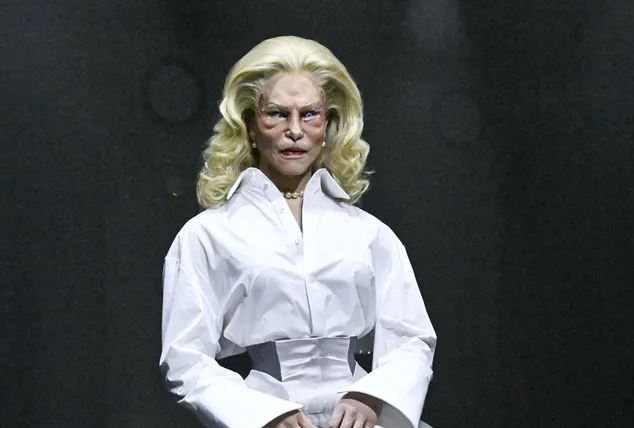
The most immediate reaction to recent images from Paris Fashion Week 2026 is to dismiss them as excess, noise, or empty provocation, a kind of self-indulgent spectacle detached from real life. That reaction is comfortable, but shallow. It overlooks the historical role of high fashion as a space of symbolic experimentation where what is being tested is not clothing itself, but ways of seeing the body, identity, and ultimately what it means to be human. The runway, in this sense, does not anticipate consumer trends. It pushes the boundaries of what can be imagined, gradually shifting what a culture recognizes as familiar.
Throughout history, periods of cultural stability have produced representations of the body defined by proportion, clarity, and immediate recognition. The human figure functioned as a stable reference point, almost as a symbolic anchor. In periods of transition, that stability begins to dissolve. The human form becomes less evident and starts to undergo transformations that are not merely aesthetic, but structural: distortion, fragmentation, hybridization, and the erosion of clear boundaries. This is not an isolated act of creativity, but a recurring symptom of cultures undergoing internal reorganization.
This shift had already been identified by thinkers like Friedrich Nietzsche, who linked the collapse of traditional values to a deeper crisis of identity, one that inevitably affects how the human is represented. Modern art responded to this rupture by fragmenting the body, distorting reality, and abandoning the idea of unity. What now appears on the runway does not introduce a new phenomenon, but updates it within a different context shaped by technological and cultural transformations that once again place the limits of the body and identity into question.
The concept of the grotesque offers a more precise lens for understanding this moment. The philosopher Mikhail Bakhtin described the grotesque body as open, unstable, and constantly in transformation, a body that rejects the idea of a closed and fixed form. It is a body that mixes, expands, and dissolves boundaries. This definition, far from being confined to literary theory, finds a direct echo in contemporary runway imagery, where hybrid figures, unrecognizable silhouettes, and compositions that challenge traditional anatomy are no longer exceptions, but central elements.
There is, however, a quieter mechanism underlying the effectiveness of these images. Social psychology has shown that repetition reduces resistance to the unfamiliar. The work of Robert Zajonc on the mere exposure effect demonstrates that what initially provokes rejection tends to become more acceptable over time when repeatedly encountered. The runway operates precisely in this space between shock and familiarity, presenting forms that have not yet been assimilated and gradually weakening the barrier that separates them from the cultural mainstream. What once seemed excessive or absurd can, through repetition, lose its disruptive force and become part of the visual norm.
This dynamic becomes even clearer when viewed through the lens of media theory, particularly in the work of Marshall McLuhan, who saw art as an early warning system capable of detecting changes before they fully emerge in everyday life. Art does not explain transformation. It expresses it, often in uncomfortable ways. Designers do not necessarily act as conscious agents of an agenda, but as interpreters of a shifting cultural environment, translating diffuse signals into visual language. The runway does not argue. It constructs images that condense unresolved tensions.
What defines the current aesthetic moment is a consistent movement toward forms that challenge the traditional idea of the human. Bodies that appear artificial, identities that resist fixed definitions, compositions that merge the organic with the synthetic all emerge at the same time that public discourse begins to grapple with advances in artificial intelligence, biotechnology, and increasingly invasive forms of bodily intervention. Fashion does not simply reflect these discussions. It operates within the same symbolic field, often anticipating them in visual form before they are fully articulated in technical or political language.
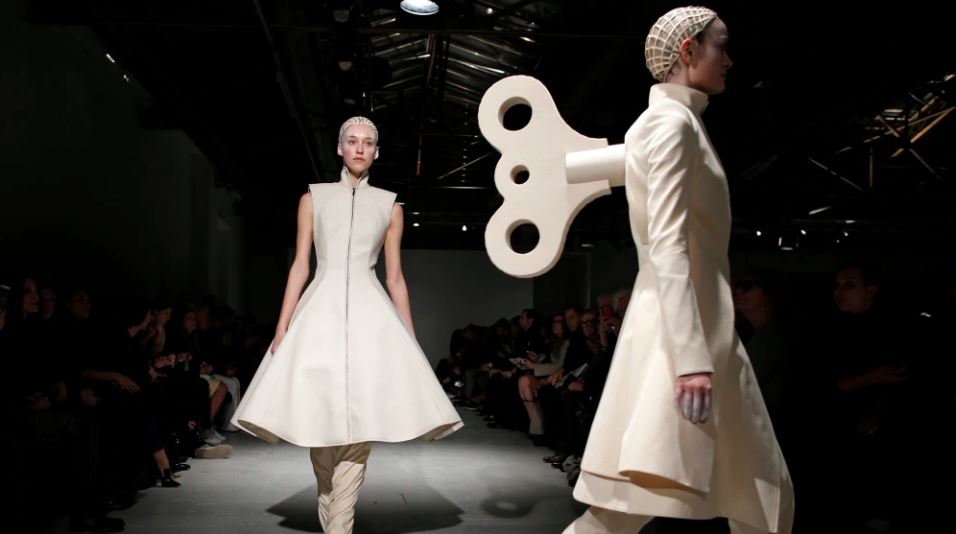
To dismiss these manifestations as disconnected from reality is to ignore that the very notion of reality is shifting. High fashion has never been about mirroring everyday life. Its function is to destabilize it, to create zones of uncertainty where new possibilities can be explored. When these zones become frequent and visible, it signals that the symbolic system supporting established definitions is beginning to lose coherence.
In this context, the recurring presence of hybrid, distorted, or non-human forms cannot be reduced to aesthetics alone. It points to a deeper process in which culture attempts to reorganize its fundamental references. The body ceases to be an obvious given and becomes a contested field, open to interpretation, intervention, and reconfiguration. The runway does not determine the outcome of this process, but it makes clear that it is already underway.
The discomfort these images generate is not incidental. It reveals the gap between what is still recognized as human and what is beginning to emerge as a possibility. Ignoring this discomfort prevents understanding. Engaging with it reveals that beneath the surface of exaggeration lies a consistent movement of symbolic transformation. When the human form loses stability in cultural representation, the issue is no longer aesthetic, but structural.
At this point, the contemporary discourse of Transhumanism no longer appears as mere technological speculation, but as a cultural project in dispute. The promise of overcoming biological limits is often framed as inevitable progress, almost as a natural evolution of the species. Yet by treating the body as something adjustable, this perspective introduces a quiet rupture: the human ceases to be a given and becomes a variable.
The aesthetic now circulating on runways does not explicitly advocate for this project, but it makes it imaginable. By normalizing forms that no longer revolve around a recognizable human structure, it weakens the idea of limits and prepares the symbolic ground for increasingly radical interventions. The issue is not technological innovation itself, but the absence of a clear boundary defining how far transformation can go without dissolving what makes the human intelligible.
A culture that loses the ability to recognize its own form risks accepting any form as a substitute. In this scenario, technology ceases to be merely a tool and becomes a force of ontological redefinition. The central question is no longer whether the body can be modified, but what is lost when it ceases to function as a stable reference. By turning the human into an open-ended project, transhumanism does not simply expand possibilities. It also destabilizes the very concept it seeks to transcend.