The Future That Never Happened
A Reverse Semiotic Reading of The Economist’s The World Ahead 2026 Cover
One year later, what did Andrew Rae’s illustration actually anticipate? What failed to materialize? And what only acquired meaning after the events had taken place?
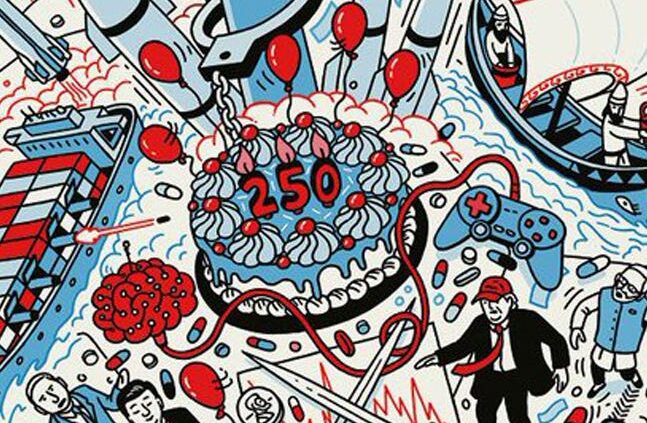
In November 2025, the British magazine The Economist released its annual The World Ahead 2026 edition. The cover, illustrated by Andrew Rae, featured a circular composition crowded with figures, objects, military equipment, technological references, pharmaceuticals, and political symbols. At the center of it all, a globe transformed into a football was set in motion by a player.
The image immediately attracted attention. And, as often happens with this publication’s covers, interpretations soon emerged that went far beyond the most obvious visual references.
Throughout 2026, various events were retrospectively associated with elements of the illustration. Others simply failed to unfold in the way certain interpretations had suggested.
Now, as the year draws to a close, we have an interesting opportunity: to return to the image, confront it with reality, and investigate what remains of its apparent expectations.
This is not about searching for a prophecy in every drawing. Nor is it about attributing predictions to the publication that it never actually made. The proposal is to conduct a reverse semiotic reading: starting with the events and working our way back to the signs, examining which expectations found parallels in reality and which lost their foundations.
The goal is not to determine whether the cover got everything right or wrong. It is to understand what happens when we confront an image of the future with the future that actually unfolded.
1. The World Turned Into a Ball
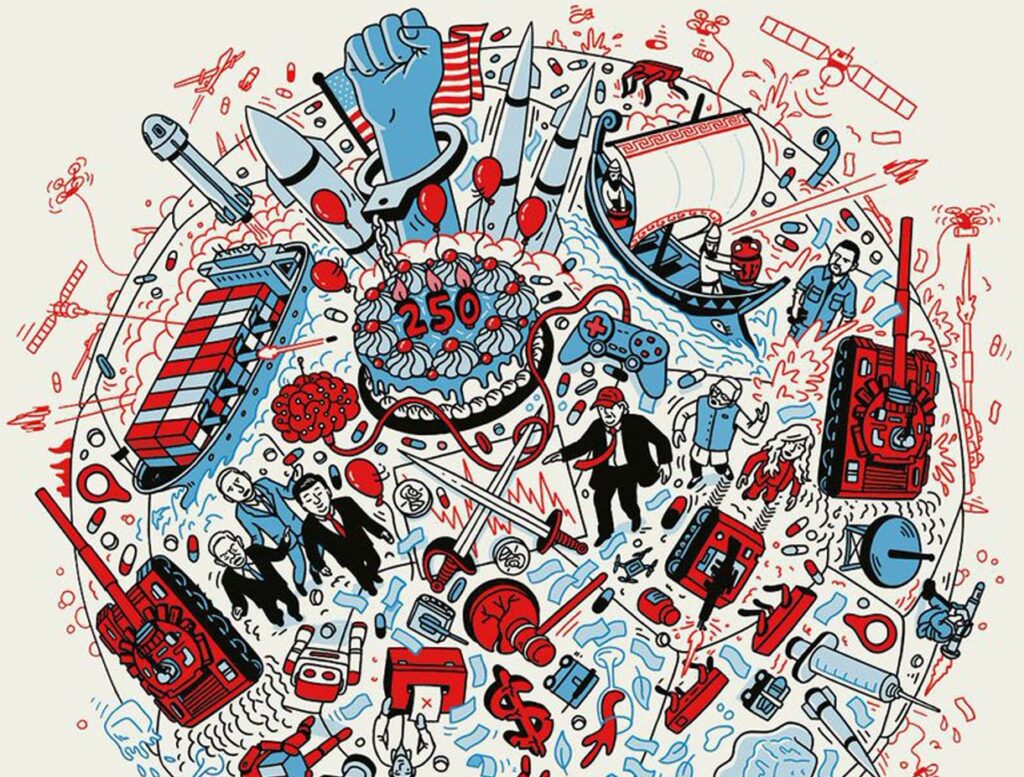
The first visual choice worth examining is the very structure of the composition. The planet appears as a ball, surrounded by a multitude of events and figures. We are not looking at an organized representation of the world, with borders, continents, and countries. Instead, we see a sphere filled with events, as though everything were in motion and could be struck, displaced, or drawn into a contest.
The player in the lower-right corner appears to set this world in motion with a kick. The most immediate association is the 2026 FIFA World Cup, hosted by the United States, Mexico, and Canada. But transforming the entire planet into a ball also allows for a broader interpretation: the world as a field of competition, where different forces attempt to determine the direction of events.
The tournament took place. And it did so on a record-breaking scale: 104 matches, 48 national teams, and approximately 6.81 million spectators in the stadiums. On this particular point, we are not looking at an expectation that failed to materialize.
There is, however, an intriguing detail. On social media, the player’s red shirt was interpreted as an advance indication of a Spanish victory. Spain did indeed win the title, defeating Argentina 1–0 in extra time.
A coincidence that gained retrospective significance because the outcome matched the interpretation. Nevertheless, there is no evidence that the character’s clothing was originally intended to identify the eventual champions. That interpretation was constructed around a result that became known later. Before the final, every team wearing red could have become the target of the same symbolic association.
This distinction is important to our analysis: the fact that an event coincides with an interpretation does not demonstrate that the interpretation was originally encoded in the image.
Reality can assign new meanings to a sign without those meanings having been part of its initial intention.
2. The Handcuffed Fist: A Coincidence Hard to Ignore
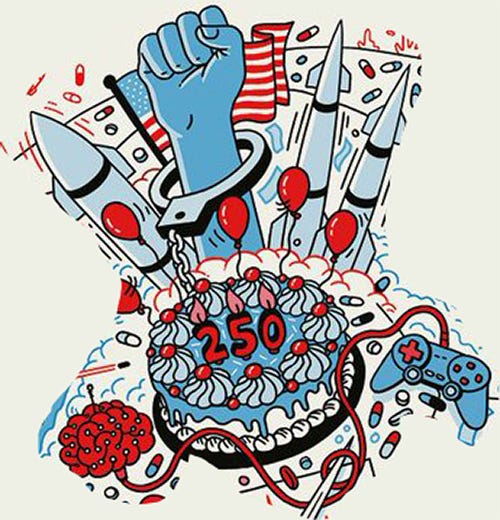
Among the most intriguing elements of the composition is a blue hand in handcuffs. In interpretations circulating online, the image was associated with the possibility of the arrest of Nicolás Maduro, Venezuela’s president. And here we have an event worth documenting.
On January 3, 2026, United States military forces carried out an operation in Venezuela that resulted in the capture of Maduro and his wife, Cilia Flores. Both were taken to the United States to face criminal charges. The episode was documented by the U.S. Congressional Research Service.
A real event. The association between the handcuffed fist and Maduro’s capture gained strength after the operation. But we must distinguish between the two things: there is no confirmation that the illustration was designed to represent Maduro, let alone to anticipate that particular operation.
What we have is an extraordinarily suggestive visual and temporal coincidence. From a semiotic perspective, this case is particularly interesting because it demonstrates how the meaning of an image can be reorganized by subsequent events.
Before the operation, the handcuffed fist could have represented restraint, repression, imprisonment, or limitations on power. Afterward, it became associated with a specific political figure. The sign remained the same, but the context changed.
And this brings us to an important question: how many interpretations that seem obvious today only became possible because we already know what happened?
3. The 250th Anniversary Cake: Celebration and Its Contradictions
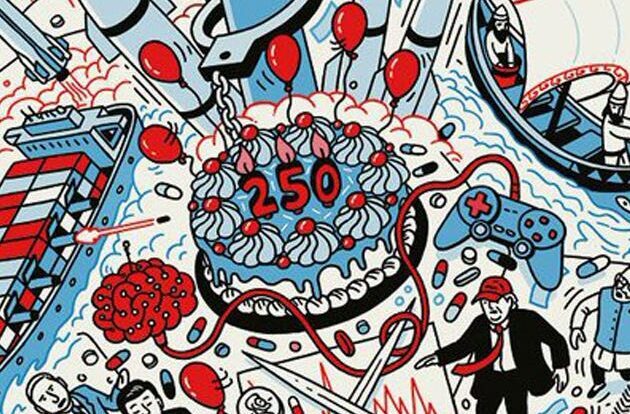
The cake bearing the number 250 is one of the cover’s most straightforward references: the 250th anniversary of American independence, celebrated on July 4, 2026. The anniversary took place, naturally. The country organized a nationwide program of celebrations, including official events and public initiatives.
But the interpretation does not need to end with the confirmation of the date. A cake is a symbol of celebration, continuity, and collective identity. Yet the American context in 2026 was marked by deep political divisions and disputes over how the nation’s own history should be interpreted.
A Marquette Law School poll, conducted in June, found that only 26% of respondents had heard a great deal about the celebrations, while just 17% said they were very interested in the event.
Another survey, conducted by Gallup, found that 66% of Americans intended to celebrate the anniversary in some way. These figures are not contradictory: they measure different things — public awareness and the intention to celebrate, respectively.
What matters to our analysis is the gap between visual representation and political reality. The anniversary happened, and so did the celebrations. But the symbol of a nation united around its own history confronts a society that does not necessarily share a common interpretation of that history.
The cake represents the anniversary. It does not, in itself, represent national reconciliation.
4. The War That Continued to Occupy the World
Tanks, missiles, ships, and military equipment are scattered throughout the composition. Their presence is far from subtle. The visual vocabulary of warfare occupies a significant portion of the illustration.
In November 2025, when the cover was released, conflicts in Ukraine, Sudan, and Myanmar were already part of the international landscape. In 2026, militarization and geopolitical instability remained prominent, with further escalations and confrontations.
The war between Russia and Ukraine remained active. Sudan continued to face one of the world’s most severe humanitarian crises, while the Middle East once again experienced large-scale confrontations.
In November, the United States and Iran remained locked in a military standoff following months of war. Therefore, this is not a prediction that failed to materialize. But there is an interesting visual aspect worth considering: war appears as part of the world’s landscape, almost as a permanent component of its organization.
The composition offers no narrative of resolution. Weapons, vehicles, and military equipment coexist with technology, economics, healthcare, and entertainment. War is not presented as an exception that interrupts normality. It is integrated into the very representation of normality.
5. Pharmaceuticals: The Future That Reached the Pharmacies
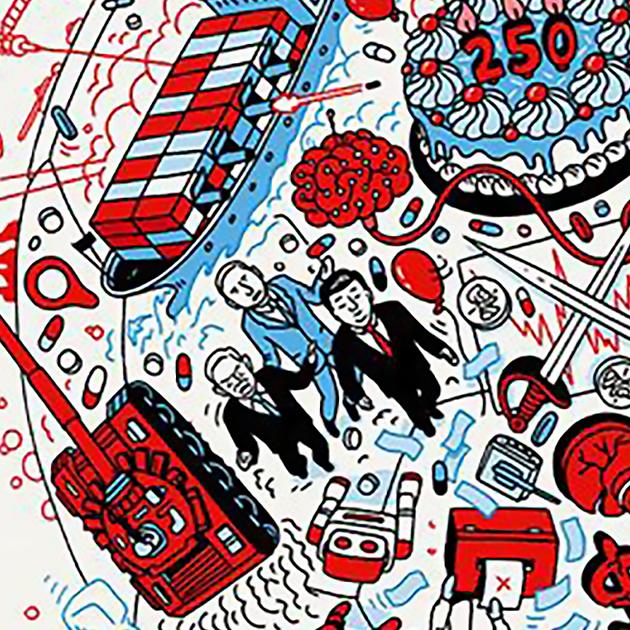
Syringes and pills are also prominent in the illustration. The visual reference is commonly associated with the expansion of weight-loss medications, particularly GLP-1 treatments. Here, once again, reality offered concrete parallels.
In 2026, oral obesity medications reached the American market. In November, usage data for the Wegovy pill indicated an average body-weight reduction of 6.2% after three months among the patients analyzed.
This is one of the elements that found a tangible counterpart in the year’s technological and pharmaceutical developments. But there is a difference between anticipating the expansion of a category of medication and predicting its social consequences.
The image presents pharmaceuticals as part of a world undergoing transformation. It does not allow us to conclude, on its own, that broader access, lower costs, or the long-term effects of these treatments would be resolved in 2026.
6. Technology, Satellites, and the Connected Brain
The composition also brings together satellites, technological elements, and a depiction of a brain associated with a video game controller. Here, we need to be careful not to turn every object into a specific prediction.
The satellite may refer to the growing importance of space infrastructure, communications, and technological competition. The brain and controller may suggest an increasingly close relationship between cognition, entertainment, and technology. Or they may not.
The cover does not tell us which space mission would take place, which technology would be launched, or what specific transformation would occur. The most consistent reading is thematic: technology and digital infrastructure as forces cutting across different dimensions of contemporary life.
There is insufficient evidence to classify these elements as successful or failed predictions. And this is worth emphasizing: a serious analysis must also know when an image does not provide enough information to support a conclusion.
7. So, What Didn’t Happen?
We have reached the most important point in our investigation.
After confronting the illustration with the events of 2026, we find something curious: the cover’s most easily identifiable elements had obvious counterparts in reality.
| Cover element | What happened in 2026 |
|---|---|
| Player and globe | World Cup held; Spain became champion |
| Handcuffed fist | Maduro captured by the United States |
| 250th anniversary cake | United States celebrated its 250th anniversary |
| Tanks and missiles | Ongoing conflicts and military escalations |
| Syringes and pills | Expansion of oral GLP-1 treatments |
| Satellites and technology | Technological themes remained relevant |
Does this mean the cover predicted all these events? Of course not.
It means the image was built around sufficiently broad references to themes that were already developing and would remain relevant in the following year. The problem arises when subsequent interpretations turn those references into detailed predictions.
The association between the player in red and Spain’s victory is one example. The association between the handcuffed fist and Maduro’s capture is another.
Both gained traction because the events actually happened. But neither proves that an intentional prediction was encoded in the illustration.
And here is the central point of our reverse reading: we have not found a collection of specific predictions that failed. We have found a thematic image that allows for countless retrospective associations, including some that appear extraordinarily accurate once we already know what happened.
That does not make the investigation any less interesting. It makes it all the more necessary.
8. What Does the Cover Reveal About the Way We See the Future?
Andrew Rae’s composition works with an important characteristic: simultaneity.
Everything seems to be happening at once. Politics, war, healthcare, economics, technology, and entertainment all occupy the same space.
The circle brings different elements together, but establishes no chronological order between them. There is no sequence indicating which event will come first, which will be the consequence of another, or which might be prevented.
The image offers a vision of a world in motion, shaped by competing forces and transformations. It is a remarkably effective visual representation of the contemporary perception of instability.
But the reverse semiotic reading allows us to observe something else: how easily the observer reorganizes signs after events have taken place.
The player becomes Spanish. The fist becomes Maduro. The cake comes to represent a particular interpretation of American politics or even the anniversary celebration of the Illuminati.
The image’s past is rewritten by the observer’s present. This is precisely where one of the most interesting questions in symbolism lies: a symbol does not need to have predicted an event to become associated with it afterward.
And the more open-ended and densely populated a composition is with references, the greater the number of associations it can generate.
Conclusion: The Future Wasn’t Necessarily Drawn
Looking back at The World Ahead 2026 leaves us with an important lesson for our next investigation.
The Economist cover presented a set of themes that genuinely shaped the year. Some associations made before the events found parallels in what followed, while others acquired meaning only after reality provided the material needed to reinterpret them.
But it would not be intellectually honest to present every coincidence as a confirmed prediction, or to invent failed predictions where the illustration never established any in the first place.
Have you ever wondered why we find it so easy to discover predictions in images after the events have already happened?
Are we identifying a genuine anticipation of the future, or reorganizing signs so that they fit what we already know?
These are the questions with which we should conclude our 2026 investigation. Because now we have a new cover in front of us.
And before searching for what it supposedly announces for 2027, it is worth remembering what we learned by looking at the previous one again.
Most people look. Few notice. But noticing also requires knowing how to distinguish what was actually in the image from what we have added to it.